> ## Documentation Index
> Fetch the complete documentation index at: https://docs.phosra.com/llms.txt
> Use this file to discover all available pages before exploring further.
# Connect a platform
> Link a family to an external platform end-to-end — the OAuth connect ceremony, run live against the open sandbox with real requests and responses.
A **platform** (also called a *provider*) is anything Phosra can push a child-safety policy
to — a DNS filter, a router, an app, an operating system. Before Phosra can enforce anything,
a parent has to connect the platform and approve sharing their children's profiles.
This guide walks the full **connect ceremony** — discovery → consent → token → profiles —
against the public sandbox. Every request and response below is **verbatim live output**,
captured while writing this page. No API key, nothing to install.
The four calls chain end to end: **discover** the endpoints (`GET /providers/{did}/connect`) →
send the parent to **consent** (`authorize_url`) → exchange the returned code for a **token**
(`token_url`) → read the approved **profiles** (`profiles_url`). Each step below carries a
**Fields & errors** reference you can expand.
**Sandbox-first.** The reference provider used here — `did:ocss:loopline` — is seeded into the
partner sandbox at `https://phosra-api-sandbox-production.up.railway.app`. Nothing you connect
there touches a real family. The endpoint shapes are identical in production; you swap the base
URL for `https://prodapi.phosra.com` and connect a real provider DID.
## Before you start
Set the base URL once so every step is copy-paste:
```bash theme={null}
export PHOSRA_BASE="https://phosra-api-sandbox-production.up.railway.app"
```
You will connect the sandbox's reference provider, **Loopline** (`did:ocss:loopline`). It is a
real, accredited entry on the sandbox [Trust List](/guides/test-in-sandbox) with a live OAuth
surface — the same shape a production provider exposes.
Every connectable provider publishes its OAuth endpoints at
`GET /providers/{did}/connect`. Start there — never hard-code the URLs.
```bash cURL theme={null}
curl -s "$PHOSRA_BASE/api/v1/providers/did:ocss:loopline/connect"
```
```typescript TypeScript theme={null}
const BASE = "https://phosra-api-sandbox-production.up.railway.app";
const res = await fetch(`${BASE}/api/v1/providers/did:ocss:loopline/connect`);
const connect = await res.json();
// connect.authorize_url, connect.token_url, connect.profiles_url, connect.scopes
```
```python Python theme={null}
import requests
BASE = "https://phosra-api-sandbox-production.up.railway.app"
connect = requests.get(
f"{BASE}/api/v1/providers/did:ocss:loopline/connect", timeout=30
).json()
# connect["authorize_url"], connect["token_url"], connect["profiles_url"]
```
```go Go theme={null}
const base = "https://phosra-api-sandbox-production.up.railway.app"
res, _ := http.Get(base + "/api/v1/providers/did:ocss:loopline/connect")
defer res.Body.Close()
// decode into { AuthorizeURL, TokenURL, ProfilesURL, Scopes, Name }
```
**Real response (200):**
```json theme={null}
{
"authorize_url": "https://phosra-api-sandbox-production.up.railway.app/oauth/authorize",
"token_url": "https://phosra-api-sandbox-production.up.railway.app/oauth/token",
"profiles_url": "https://phosra-api-sandbox-production.up.railway.app/oauth/profiles",
"scopes": ["child_profiles.read"],
"name": "Loopline"
}
```
A provider that is accredited but has **not** configured a connect surface returns
`404 provider connect config not available`. In the sandbox, `did:ocss:courier` is deliberately
left unconfigured so you can test that branch.
**Path parameter**
| Field | Type | Required | Description |
| ----- | ------ | :------: | --------------------------------------------------------------------------------------------------------------------------------------- |
| `did` | string | yes | The provider's decentralized identifier, e.g. `did:ocss:loopline`. URL-encode the `:` characters if your client does not do it for you. |
**Response fields (200)**
| Field | Type | Description |
| --------------- | ------------ | -------------------------------------------------------------------------------------------------------------------------------- |
| `authorize_url` | string (URL) | Where you send the parent's browser to grant consent (step 2). |
| `token_url` | string (URL) | Where you exchange the authorization `code` for a token (step 4). |
| `profiles_url` | string (URL) | Where you read the approved child profiles with the token. |
| `scopes` | string\[] | The OAuth scopes the provider will request. Loopline requests `child_profiles.read` — read-only access to the approved children. |
| `name` | string | Human-readable provider name, safe to show a parent. |
**Errors**
| Status | `message` | When it happens |
| :----: | --------------------------------------- | ------------------------------------------------------------------------------------------------------------------------------------------------ |
| `404` | `provider connect config not available` | The DID is accredited but has no connect surface configured (e.g. `did:ocss:courier`). Do not retry — the provider must publish endpoints first. |
| `404` | `provider not found` | The DID is not on the Trust List at all. Check the value against [`GET /.well-known/ocss/trust-list`](/guides/test-in-sandbox). |
Redirect the parent's browser to `authorize_url` with your `client_id` (the provider DID),
a `redirect_uri`, and an opaque `state` you generate:
```
GET /oauth/authorize
?client_id=did:ocss:loopline
&redirect_uri=https://loopline.example/callback
&state=xyz789
&response_type=code
```
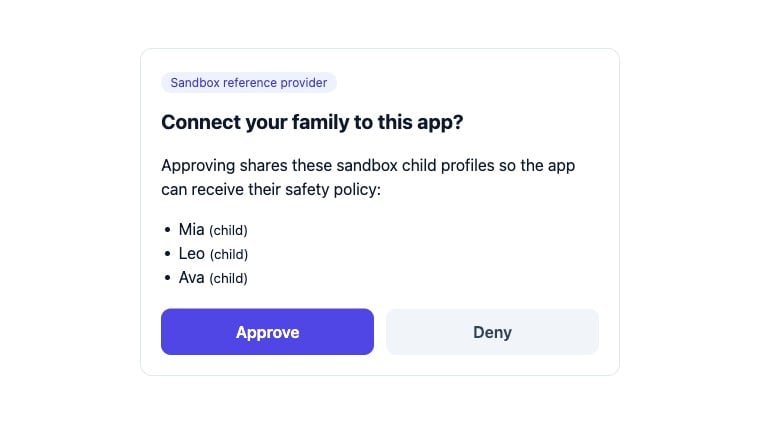
The sandbox serves a real consent screen. The parent sees exactly which child profiles they
are about to share, and chooses **Approve** or **Deny**:
 **Query parameters**
| Field | Type | Required | Description |
| --------------- | ------------ | :------: | ---------------------------------------------------------------------------------------------------------------------------- |
| `client_id` | string | yes | The provider DID you are connecting, e.g. `did:ocss:loopline`. |
| `redirect_uri` | string (URL) | yes | Where Phosra sends the parent back after they decide. Custom schemes (e.g. `myapp://callback`) are accepted for native apps. |
| `state` | string | yes | An opaque value you generate. It is echoed back unchanged — compare it on return to defend against CSRF. |
| `response_type` | string | yes | Always `code` for this flow. |
**Outcomes**
| Result | What Phosra returns |
| ------------------- | ----------------------------------------------------------------------------------------------------------------------------------------------------------- |
| Parent **approves** | `302` redirect to `redirect_uri?code=…&state=…` (step 3). |
| Parent **denies** | `302` redirect to `redirect_uri?error=access_denied&state=…` — **no code**. Handle this branch; see [Disconnect & reconnect](/guides/disconnect-reconnect). |
**Errors**
| Status | When it happens |
| :----: | -------------------------------------------------------------------------------------------------------------------------------- |
| `400` | `redirect_uri` is missing or malformed. Phosra will not redirect to an absent callback, so it fails closed with a `400` instead. |
On **Approve**, Phosra redirects back to your `redirect_uri` with a short-lived `code` and the
`state` you sent (verify it matches before continuing):
```
302 Location: https://loopline.example/callback?code=sbxauth_2hg1obaYzTs5XiK80A-NnuVhzOHfktze&state=xyz789
```
On **Deny**, no code is issued — you get `?error=access_denied&state=…` instead. Handle both.
See [Disconnect & reconnect](/guides/disconnect-reconnect) for the decline path in full.
**Query parameters Phosra appends to your `redirect_uri`**
| Field | Type | Present when | Description |
| ------- | ------ | ------------ | --------------------------------------------------------------------------------------------------- |
| `code` | string | approved | Short-lived authorization code (`sbxauth_…` in the sandbox). Exchange it once at `token_url`. |
| `state` | string | always | The exact `state` you sent. **Reject the response if it does not match** the value you generated. |
| `error` | string | denied | `access_denied` when the parent declined. No `code` is present — do not attempt the token exchange. |
Trade the `code` for a bearer token at `token_url`:
```bash cURL theme={null}
curl -s -X POST "$PHOSRA_BASE/oauth/token" \
-H "Content-Type: application/json" \
-d '{
"grant_type": "authorization_code",
"code": "sbxauth_2hg1obaYzTs5XiK80A-NnuVhzOHfktze",
"client_id": "did:ocss:loopline",
"redirect_uri": "https://loopline.example/callback"
}'
```
```typescript TypeScript theme={null}
const tok = await fetch(`${BASE}/oauth/token`, {
method: "POST",
headers: { "Content-Type": "application/json" },
body: JSON.stringify({
grant_type: "authorization_code",
code, // from the callback
client_id: "did:ocss:loopline",
redirect_uri: "https://loopline.example/callback",
}),
}).then((r) => r.json());
// tok.access_token, tok.expires_in
```
```python Python theme={null}
tok = requests.post(f"{BASE}/oauth/token", json={
"grant_type": "authorization_code",
"code": code, # from the callback
"client_id": "did:ocss:loopline",
"redirect_uri": "https://loopline.example/callback",
}, timeout=30).json()
# tok["access_token"], tok["expires_in"]
```
```go Go theme={null}
body, _ := json.Marshal(map[string]string{
"grant_type": "authorization_code",
"code": code, // from the callback
"client_id": "did:ocss:loopline",
"redirect_uri": "https://loopline.example/callback",
})
res, _ := http.Post(base+"/oauth/token", "application/json", bytes.NewReader(body))
defer res.Body.Close()
// decode { AccessToken, ExpiresIn, Scope, TokenType }
```
**Real response (200):**
```json theme={null}
{
"access_token": "sbxtok_ymSQQBw4aPijjuX8xuU5R6ASjrDSXXC6",
"expires_in": 3600,
"scope": "profiles",
"token_type": "Bearer"
}
```
**On the `scope` value.** Discovery advertises the requested scope as `child_profiles.read`
(the canonical name), while the issued token echoes the short form `scope: "profiles"`. **Both
name the same grant** — read-only access to the approved children. Key your logic off the token
you were issued, not off a hard-coded string, and treat the two as equivalent.
**Request body** (`application/json`)
| Field | Type | Required | Description |
| -------------- | ------ | :------: | -------------------------------------------------------------- |
| `grant_type` | string | yes | Always `authorization_code` for this flow. |
| `code` | string | yes | The authorization code from the callback. |
| `client_id` | string | yes | The provider DID — must match the one you sent to `authorize`. |
| `redirect_uri` | string | yes | Must match the `redirect_uri` used at `authorize`. |
**Response fields (200)**
| Field | Type | Description |
| -------------- | ------- | -------------------------------------------------------------------------------------------------------------------------- |
| `access_token` | string | Bearer token (`sbxtok_…`) for `GET /oauth/profiles`. |
| `expires_in` | integer | Seconds until the token expires (`3600` = 1 hour). |
| `scope` | string | The granted scope, returned as `profiles` — equivalent to the `child_profiles.read` scope from discovery (see note above). |
| `token_type` | string | Always `Bearer`. Send it as `Authorization: Bearer `. |
**Errors**
| Status | `error` | When it happens |
| :----: | ------------------------ | ---------------------------------------------------- |
| `400` | `unsupported_grant_type` | `grant_type` is missing or not `authorization_code`. |
| `400` | `invalid_request` | The body is malformed or a required field is absent. |
**Sandbox stub behaviour.** The sandbox `/oauth/token` surface is a **stateless reference stub**:
it does not persist or validate the `code`, so an expired or reused code still returns a token in
the sandbox. In production, a provider's real token endpoint returns `400 invalid_grant` for an
expired, reused, or unknown code — write your error handling for that before you go live.
Call `profiles_url` with the token. You get back exactly the children the parent approved —
each with a stable `subject_ref` you use for policy and enforcement calls:
```bash cURL theme={null}
curl -s "$PHOSRA_BASE/oauth/profiles" \
-H "Authorization: Bearer sbxtok_ymSQQBw4aPijjuX8xuU5R6ASjrDSXXC6"
```
```typescript TypeScript theme={null}
const profiles = await fetch(`${BASE}/oauth/profiles`, {
headers: { Authorization: `Bearer ${tok.access_token}` },
}).then((r) => r.json());
// [{ id, displayName, subject_ref, kind }, …]
```
```python Python theme={null}
profiles = requests.get(f"{BASE}/oauth/profiles", headers={
"Authorization": f"Bearer {tok['access_token']}",
}, timeout=30).json()
```
```go Go theme={null}
req, _ := http.NewRequest("GET", base+"/oauth/profiles", nil)
req.Header.Set("Authorization", "Bearer "+tok.AccessToken)
res, _ := http.DefaultClient.Do(req)
defer res.Body.Close()
// decode []Profile{ ID, DisplayName, SubjectRef, Kind }
```
**Real response (200):**
```json theme={null}
[
{ "id": "mia", "displayName": "Mia", "subject_ref": "a11ce0fa-0000-4000-8000-0000000000a1", "kind": "child" },
{ "id": "leo", "displayName": "Leo", "subject_ref": "a11ce0fa-0000-4000-8000-0000000000a2", "kind": "child" },
{ "id": "ava", "displayName": "Ava", "subject_ref": "a11ce0fa-0000-4000-8000-0000000000a3", "kind": "child" }
]
```
The platform is now connected. Hold onto each `subject_ref` — that is the handle you pass to
the policy and enforcement endpoints in [Set up a family & kids](/guides/family-and-kids).
**Request header**
| Header | Required | Description |
| --------------- | :------: | -------------------------------------------- |
| `Authorization` | yes | `Bearer ` from the token step. |
**Response fields (200)** — an array, one object per approved child
| Field | Type | Description |
| ------------- | ------------- | ------------------------------------------------------------------------------------------------------------------------- |
| `id` | string | Provider-local child id (e.g. `mia`). |
| `displayName` | string | Child's display name, safe to show a parent. |
| `subject_ref` | string (UUID) | **Stable cross-system handle.** Pass this to the policy and enforcement endpoints — it does not change across reconnects. |
| `kind` | string | Subject kind, `child` for these entries. |
**Errors**
| Status | `error` | When it happens |
| :----: | --------------- | ----------------------------------- |
| `401` | `invalid_token` | No `Authorization` header was sent. |
**Sandbox stub behaviour.** Because the sandbox surface is stateless, any non-empty
`Bearer` value returns the seeded profiles — only a **missing** header yields `401`. A production
provider validates the token and returns `401 invalid_token` for any expired or forged token, so
treat `401` as "re-run the connect ceremony" in your client.
## Which platform supports which rule?
Not every platform can enforce every rule. Discovery endpoints let you pick the right one
before you ask a parent to connect:
```bash Find by capability theme={null}
# Every platform that can do DNS-level web filtering
curl -s "$PHOSRA_BASE/api/v1/platforms/by-capability?capability=web_filtering"
# → [ "fire_tablet", "apple", "microsoft", "cleanbrowsing", "controld", "nextdns" ]
```
```bash Find by category theme={null}
# Every DNS platform
curl -s "$PHOSRA_BASE/api/v1/platforms/by-category?category=dns"
# → [ "cleanbrowsing", "controld", "nextdns" ]
```
```bash Inspect one platform theme={null}
curl -s "$PHOSRA_BASE/api/v1/platforms/nextdns"
# → { "id": "nextdns", "category": "dns", "enforcement_mode": "dns",
# "auth_type": "api_key", "capabilities": ["web_filtering", "safe_search", …],
# "rule_support": { … per-rule "supported" | "unsupported" … } }
```
Check each platform's **`enforcement_mode`**: `dns`, `device`, and `oauth2` platforms are
applied programmatically, while `manual_attested` platforms require the parent to complete a
guided step by hand. See [Platforms & enforcement modes](/concepts/platforms).
## Production notes
In production, connecting an **account-linked** platform (one where you hold a per-family
credential rather than an OAuth grant) uses `POST /compliance` with your `phosra_live_…` key —
see [First-time setup](/guides/first-time-setup). Those endpoints are family-scoped and require
an authenticated caller who is a member of the family, so they cannot be exercised
anonymously against the open sandbox. The OAuth ceremony above is the anonymous, fully
runnable path.
## Next steps
Build a family, add children, and get an age-appropriate policy in one call.
Handle the decline path, tear a link down, and re-approve cleanly.
**Query parameters**
| Field | Type | Required | Description |
| --------------- | ------------ | :------: | ---------------------------------------------------------------------------------------------------------------------------- |
| `client_id` | string | yes | The provider DID you are connecting, e.g. `did:ocss:loopline`. |
| `redirect_uri` | string (URL) | yes | Where Phosra sends the parent back after they decide. Custom schemes (e.g. `myapp://callback`) are accepted for native apps. |
| `state` | string | yes | An opaque value you generate. It is echoed back unchanged — compare it on return to defend against CSRF. |
| `response_type` | string | yes | Always `code` for this flow. |
**Outcomes**
| Result | What Phosra returns |
| ------------------- | ----------------------------------------------------------------------------------------------------------------------------------------------------------- |
| Parent **approves** | `302` redirect to `redirect_uri?code=…&state=…` (step 3). |
| Parent **denies** | `302` redirect to `redirect_uri?error=access_denied&state=…` — **no code**. Handle this branch; see [Disconnect & reconnect](/guides/disconnect-reconnect). |
**Errors**
| Status | When it happens |
| :----: | -------------------------------------------------------------------------------------------------------------------------------- |
| `400` | `redirect_uri` is missing or malformed. Phosra will not redirect to an absent callback, so it fails closed with a `400` instead. |
On **Approve**, Phosra redirects back to your `redirect_uri` with a short-lived `code` and the
`state` you sent (verify it matches before continuing):
```
302 Location: https://loopline.example/callback?code=sbxauth_2hg1obaYzTs5XiK80A-NnuVhzOHfktze&state=xyz789
```
On **Deny**, no code is issued — you get `?error=access_denied&state=…` instead. Handle both.
See [Disconnect & reconnect](/guides/disconnect-reconnect) for the decline path in full.
**Query parameters Phosra appends to your `redirect_uri`**
| Field | Type | Present when | Description |
| ------- | ------ | ------------ | --------------------------------------------------------------------------------------------------- |
| `code` | string | approved | Short-lived authorization code (`sbxauth_…` in the sandbox). Exchange it once at `token_url`. |
| `state` | string | always | The exact `state` you sent. **Reject the response if it does not match** the value you generated. |
| `error` | string | denied | `access_denied` when the parent declined. No `code` is present — do not attempt the token exchange. |
Trade the `code` for a bearer token at `token_url`:
```bash cURL theme={null}
curl -s -X POST "$PHOSRA_BASE/oauth/token" \
-H "Content-Type: application/json" \
-d '{
"grant_type": "authorization_code",
"code": "sbxauth_2hg1obaYzTs5XiK80A-NnuVhzOHfktze",
"client_id": "did:ocss:loopline",
"redirect_uri": "https://loopline.example/callback"
}'
```
```typescript TypeScript theme={null}
const tok = await fetch(`${BASE}/oauth/token`, {
method: "POST",
headers: { "Content-Type": "application/json" },
body: JSON.stringify({
grant_type: "authorization_code",
code, // from the callback
client_id: "did:ocss:loopline",
redirect_uri: "https://loopline.example/callback",
}),
}).then((r) => r.json());
// tok.access_token, tok.expires_in
```
```python Python theme={null}
tok = requests.post(f"{BASE}/oauth/token", json={
"grant_type": "authorization_code",
"code": code, # from the callback
"client_id": "did:ocss:loopline",
"redirect_uri": "https://loopline.example/callback",
}, timeout=30).json()
# tok["access_token"], tok["expires_in"]
```
```go Go theme={null}
body, _ := json.Marshal(map[string]string{
"grant_type": "authorization_code",
"code": code, // from the callback
"client_id": "did:ocss:loopline",
"redirect_uri": "https://loopline.example/callback",
})
res, _ := http.Post(base+"/oauth/token", "application/json", bytes.NewReader(body))
defer res.Body.Close()
// decode { AccessToken, ExpiresIn, Scope, TokenType }
```
**Real response (200):**
```json theme={null}
{
"access_token": "sbxtok_ymSQQBw4aPijjuX8xuU5R6ASjrDSXXC6",
"expires_in": 3600,
"scope": "profiles",
"token_type": "Bearer"
}
```
**On the `scope` value.** Discovery advertises the requested scope as `child_profiles.read`
(the canonical name), while the issued token echoes the short form `scope: "profiles"`. **Both
name the same grant** — read-only access to the approved children. Key your logic off the token
you were issued, not off a hard-coded string, and treat the two as equivalent.
**Request body** (`application/json`)
| Field | Type | Required | Description |
| -------------- | ------ | :------: | -------------------------------------------------------------- |
| `grant_type` | string | yes | Always `authorization_code` for this flow. |
| `code` | string | yes | The authorization code from the callback. |
| `client_id` | string | yes | The provider DID — must match the one you sent to `authorize`. |
| `redirect_uri` | string | yes | Must match the `redirect_uri` used at `authorize`. |
**Response fields (200)**
| Field | Type | Description |
| -------------- | ------- | -------------------------------------------------------------------------------------------------------------------------- |
| `access_token` | string | Bearer token (`sbxtok_…`) for `GET /oauth/profiles`. |
| `expires_in` | integer | Seconds until the token expires (`3600` = 1 hour). |
| `scope` | string | The granted scope, returned as `profiles` — equivalent to the `child_profiles.read` scope from discovery (see note above). |
| `token_type` | string | Always `Bearer`. Send it as `Authorization: Bearer `. |
**Errors**
| Status | `error` | When it happens |
| :----: | ------------------------ | ---------------------------------------------------- |
| `400` | `unsupported_grant_type` | `grant_type` is missing or not `authorization_code`. |
| `400` | `invalid_request` | The body is malformed or a required field is absent. |
**Sandbox stub behaviour.** The sandbox `/oauth/token` surface is a **stateless reference stub**:
it does not persist or validate the `code`, so an expired or reused code still returns a token in
the sandbox. In production, a provider's real token endpoint returns `400 invalid_grant` for an
expired, reused, or unknown code — write your error handling for that before you go live.
Call `profiles_url` with the token. You get back exactly the children the parent approved —
each with a stable `subject_ref` you use for policy and enforcement calls:
```bash cURL theme={null}
curl -s "$PHOSRA_BASE/oauth/profiles" \
-H "Authorization: Bearer sbxtok_ymSQQBw4aPijjuX8xuU5R6ASjrDSXXC6"
```
```typescript TypeScript theme={null}
const profiles = await fetch(`${BASE}/oauth/profiles`, {
headers: { Authorization: `Bearer ${tok.access_token}` },
}).then((r) => r.json());
// [{ id, displayName, subject_ref, kind }, …]
```
```python Python theme={null}
profiles = requests.get(f"{BASE}/oauth/profiles", headers={
"Authorization": f"Bearer {tok['access_token']}",
}, timeout=30).json()
```
```go Go theme={null}
req, _ := http.NewRequest("GET", base+"/oauth/profiles", nil)
req.Header.Set("Authorization", "Bearer "+tok.AccessToken)
res, _ := http.DefaultClient.Do(req)
defer res.Body.Close()
// decode []Profile{ ID, DisplayName, SubjectRef, Kind }
```
**Real response (200):**
```json theme={null}
[
{ "id": "mia", "displayName": "Mia", "subject_ref": "a11ce0fa-0000-4000-8000-0000000000a1", "kind": "child" },
{ "id": "leo", "displayName": "Leo", "subject_ref": "a11ce0fa-0000-4000-8000-0000000000a2", "kind": "child" },
{ "id": "ava", "displayName": "Ava", "subject_ref": "a11ce0fa-0000-4000-8000-0000000000a3", "kind": "child" }
]
```
The platform is now connected. Hold onto each `subject_ref` — that is the handle you pass to
the policy and enforcement endpoints in [Set up a family & kids](/guides/family-and-kids).
**Request header**
| Header | Required | Description |
| --------------- | :------: | -------------------------------------------- |
| `Authorization` | yes | `Bearer ` from the token step. |
**Response fields (200)** — an array, one object per approved child
| Field | Type | Description |
| ------------- | ------------- | ------------------------------------------------------------------------------------------------------------------------- |
| `id` | string | Provider-local child id (e.g. `mia`). |
| `displayName` | string | Child's display name, safe to show a parent. |
| `subject_ref` | string (UUID) | **Stable cross-system handle.** Pass this to the policy and enforcement endpoints — it does not change across reconnects. |
| `kind` | string | Subject kind, `child` for these entries. |
**Errors**
| Status | `error` | When it happens |
| :----: | --------------- | ----------------------------------- |
| `401` | `invalid_token` | No `Authorization` header was sent. |
**Sandbox stub behaviour.** Because the sandbox surface is stateless, any non-empty
`Bearer` value returns the seeded profiles — only a **missing** header yields `401`. A production
provider validates the token and returns `401 invalid_token` for any expired or forged token, so
treat `401` as "re-run the connect ceremony" in your client.
## Which platform supports which rule?
Not every platform can enforce every rule. Discovery endpoints let you pick the right one
before you ask a parent to connect:
```bash Find by capability theme={null}
# Every platform that can do DNS-level web filtering
curl -s "$PHOSRA_BASE/api/v1/platforms/by-capability?capability=web_filtering"
# → [ "fire_tablet", "apple", "microsoft", "cleanbrowsing", "controld", "nextdns" ]
```
```bash Find by category theme={null}
# Every DNS platform
curl -s "$PHOSRA_BASE/api/v1/platforms/by-category?category=dns"
# → [ "cleanbrowsing", "controld", "nextdns" ]
```
```bash Inspect one platform theme={null}
curl -s "$PHOSRA_BASE/api/v1/platforms/nextdns"
# → { "id": "nextdns", "category": "dns", "enforcement_mode": "dns",
# "auth_type": "api_key", "capabilities": ["web_filtering", "safe_search", …],
# "rule_support": { … per-rule "supported" | "unsupported" … } }
```
Check each platform's **`enforcement_mode`**: `dns`, `device`, and `oauth2` platforms are
applied programmatically, while `manual_attested` platforms require the parent to complete a
guided step by hand. See [Platforms & enforcement modes](/concepts/platforms).
## Production notes
In production, connecting an **account-linked** platform (one where you hold a per-family
credential rather than an OAuth grant) uses `POST /compliance` with your `phosra_live_…` key —
see [First-time setup](/guides/first-time-setup). Those endpoints are family-scoped and require
an authenticated caller who is a member of the family, so they cannot be exercised
anonymously against the open sandbox. The OAuth ceremony above is the anonymous, fully
runnable path.
## Next steps
Build a family, add children, and get an age-appropriate policy in one call.
Handle the decline path, tear a link down, and re-approve cleanly.